Oh the poor bride and groom. They slave away in the last busy weeks before their big day, trying to achieve that elusive goal: the perfect seating arrangement. The one where feuding cousins are on opposite sides of the dance floor, and Uncle Carl the anesthesiologist plays wing man for the med student who’s chatting up a bridesmaid at the next table over. But when the Mr. & Mrs. enter to cheers and glide onto the dance floor, they look around and realize that their careful plotting has been horribly botched.
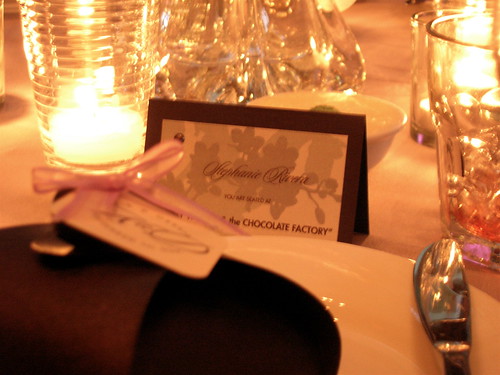
We know what’s happened. For years guests have taken it upon themselves to “improve” seating plans. If they aren’t sitting with a particular friend or family member they do what they believe is an innocuous thing; switch placecards, or “lose” escort cards. They don’t think about the fact that their seating has been carefully considered. Event staff may intervene – but more often than not, they (wisely) decline to engage this type of personality so as not to ruin a lovely evening.
How can you help? Simply put, sit where you’re asked. Period. No one stays in their assigned seats much after the entree anyway, it’s not going to kill you to wait until cake to catch up with your sorority sister across the room.
The “House Always Wins” part works like this: karma wise, you’re sealing your fate of future event tables full of Mommies & Me, Aunts Who Can’t Hear, and Uncles Who Don’t Shut Up. Plus you can count on word of your behavior getting back to the bride/groom or mothers thereof, enshrining your difficult reputation for the rest of your days. Every Christmas Party, Baby Shower, Barbeque…you’re forever “the one who messed up the wedding.” Are you good with that? No? Then reign in your inner maitre d’. Really feel the need to seat people? Open a restaurant.
Stephen Breyer, U.S. Supreme Court judge, and wedding officiant
A person would be hard pressed to find a more picture-perfect East Coast beach wedding spot than the Kennedy Compound in Hyannisport, MA. Apparently the location comes with the option of a Supreme Court Justice as officiant, and your own paparazzi. In all seriousness, congratulations to Patrick and Amy Kennedy, who were wed, yes, by Supreme Court Justice Stephen Breyer. (Who were you expecting, Scalia)? We didn’t get the best view but, we’re going to talk about the flowers as best we can. Note to the AP – zoom in on the bouquet when Maria’s daughters tie the knot, ok?
The most genuinely happy photo from any wedding: heading back down the aisle as Mr. & Mrs.Caroline Kennedy's shamrock-dotted wedding gown (and gorgeous orchid bouquet)!
The bouquet: Though from afar, looks quite beautiful – hydrangea, miniature green calla lillies, and we’re willing to bet white roses and bells-of-Ireland. Bells of Ireland are a lovely nod to the family’s Irish heritage, and they can be seen in the altar-pieces as well. The Irish history nod is a classic Kennedy bride move – check out the shamrocks on Caroline Kennedy-Schlossberg‘s custom Carolina Herrera gown. But back to the bouquet – it is “composed,” or “english garden” style meaning the flowers are grouped by type rather than all mixed together. We frequently design in this style.
Bells of Ireland - beautiful and meaningful, perfect!
Former U.S. Rep. Patrick Kennedy, D-R.I., the son of the late U.S. Sen. Edward Kennedy, kisses his wife Amy Petitgout during their wedding ceremony at the Kennedy Compound in Hyannisport, Mass., Friday, July 15, 2011. At right is Kennedy’s brother Edward Kennedy Jr. (AP Photo/Charles Krupa) / Charles Krupa/AP
Can I say first of all, that it kind of surprises me they went one-sided? A little odd. Love the containers, two very minimal stands supporting clear glass vases. The lack of subterfuge – no effort to hide stems- contributes to the organic, windblown feel. We see lovely vibrant hydrangea, and an explosion of Bells of Ireland, pink and white snapdragons (?), hanging amaranthus and delightful native grasses that make the pieces feel almost like a part of the environment. Must have been quite pretty – wish the florist had done a 360 degree arrangement.
Two lessons here:
Great photographs come from unexpected angles – assume your flowers need to be beautiful on all sides.
No wedding is perfect! Not even a Kennedy wedding! Relax!
Congrats again to Patrick and Amy! We forgive you your 2D flowers, btw. All the best to you and yours.
CLAIRE HACKNEY and Bobby Smith made two playful touches to their wedding in 2008 in Boylston, Mass. First, as gifts for the wedding party they gave puppets made to resemble each attendant.
Tom Bloom
The second touch began with the theme from “Indiana Jones.” Guests turned around and saw something almost as unexpected as a groomsman with a bullwhip and fedora: a man in a dinner jacket acting as the flower girl. Dana Jay Bein, a college friend of the bridegroom, came up the aisle tossing fresh petals from a fabric bag.
“Bobby could have told me I was going to lay down on the appetizer table, and I would have,” said Mr. Bein. “but he made me a central figure instead of just one of the guys. I was humbled.”
He added that people came up to him afterward and told him that he had been “a beautiful flower girl.”
For her otherwise traditional Filipino Catholic wedding last October in Mountain View, Calif., Jen Fernando chose her friend Sean Hopkins, 37, to be the “flower fella.” “She thought it was the perfect way to represent our friendship because it was totally our sense of humor,” Mr. Hopkins said. “When it had to be approved by the priest, I thought that would be it, but he was tickled by the idea.”
The crowd at St. Joseph, a Roman Catholic church, cheered as Mr. Hopkins tossed silk rose petals onto the carpeted path from an onion-shaped basket wrapped in silver ribbon. “I was nervous,” he said. “When I took the first petals out, I saw my hand shaking and I heard whispers, but then everyone started laughing so I could let go.”
When Kevin Peterson was married to Marlene Maginot under a vine-draped wedding canopy at an event space in Los Angeles on April 16, the flower man, Drew DiFonzo Marks, 28, wore a navy blue suit with a paper flower pinned to the lapel.
As “Then He Kissed Me” by the Crystals blared over the sound system, Mr. Marks flung handfuls of petals from his pockets while he escorted the couple’s terrier on a leash. “I didn’t smirk or mimic the saunter of a little girl,” Mr. Marks said. “I just said, ‘I’m going to do this job.’ ”
As gender roles in weddings have gradually blurred, it is less rare for the bride and bridegroom to have opposite-sex attendants or so-called honor attendants. Still, flower guys have been slower to catch on, according to Joyce Scardina Becker, a wedding planner in San Francisco and the founding president of the Wedding Industry Professionals Association.
Ms. Becker estimated that 20 percent of her weddings today feature honor attendants like a best woman or a man instead of a bridesmaid, but flower men are more of a novelty. “It’s just very uncommon,” she said.
Chrys Ingraham, a sociology professor at the SUNY College at Purchase and the author of “White Weddings: Romancing Heterosexuality in Popular Culture,” said the idea of a grown man stepping into an identity reserved by tradition for a little girl was very unusual.
“The gendered wedding is breaking down, which is allowing heterosexuals to play with the stereotypes in a way they didn’t have permission to do before,” Professor Ingraham said.
She added that although flower men might bring on waves of laughter, they did not undermine the ritual.
“You can play with the traditional mold, but in the end, you’ve had a wedding,” she said. “Whether you do it on the back of a motorcycle or underwater, it’s the same thing.”
Robert Heasley, a sociology professor at Indiana University of Pennsylvania and the president of the American Men’s Studies’ Association, said weddings were one of the last institutions to hold on to strict roles for the sexes, but that they were changing.
“We continue to have the marriage ceremony, but we’re slowly changing it to represent the greater balance of the genders,” he said. “It’s a significant shift to have the male be the flower girl because it introduces a male who represents gentility, flowers and femininity. It’s just another step toward the dismantling of the patriarchal formation of the marriage.”
Typically, the flower girl settles for a few compliments in the bride’s shadow, so it can be tricky for a man to manage the task without upstaging the bride.
“They knew I wasn’t going to take the spotlight away and that I could make it funny without it being a joke,” Mr. Marks said, referring to Ms. Fernando and her bridegroom, Michael Mackinder. “As a best man, I had given a speech and nobody came up to me. But when I did the flower-boy thing, everybody congratulated me on how I handled it. I didn’t realize I was going to get credit.”
This article has been revised to reflect the following correction:
Correction: July 10, 2011
The Field Notes column on June 26, about men taking the place of flower girls at some weddings, misstated part of the name of the organization of which Robert Heasley is the president. It is the American Men’s Studies Association, not the American Male Studies’ Association.

 The one where feuding cousins are on opposite sides of the dance floor, and Uncle Carl the anesthesiologist plays wing man for the med student who’s chatting up a bridesmaid at the next table over. But when the Mr. & Mrs. enter to cheers and glide onto the dance floor, they look around and realize that their careful plotting has been horribly botched.


